Hi, my name is Samuel Fournier, and I am a 3rd year student in Pure and Applied Science here at the Lionel-Groulx College. I created this glossary with 20 words that could be useful for the new students in this program. I chose those 20 words because I think they are really important to know when you are in this program. They are all related to this field of study and are used very commonly. Also, all these words and their meaning can teach you a lot on what you will do in this scientific program. With all the information you will acquire while reading the glossary, you will be ready for the program. After the reading, you will be able to learn new words more specific to these subject and become more educated. I would also like to thanks the websites Google and Wikipedia for helping me for this glossary. Enjoy!
analysis
noun
Detailed examination of the elements or structure of something.
Example: This meant that Bohr's model of the atom and analysis of spectral lines could lead to the prediction and discovery of unknown elements.
fr: analyse
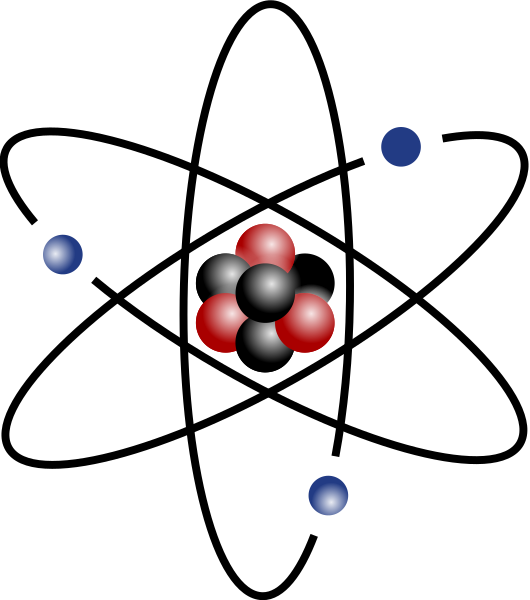
atom
noun
The basic unit of a chemical element.
Example: A normal atom exists with paired electrons orbiting around its central nucleus, while each pair moves in its own region of space.
fr: atome
biology
noun
The study of living organisms, divided into many specialized fields that cover their morphology, physiology, anatomy, behavior, origin, and distribution.
Example: In biology, the target of evolution is to produce the desired individual that is highly fit the variable environment.
fr: biologie
cell
noun
The smallest structural and functional unit of an organism, typically microscopic and consisting of cytoplasm and a nucleus enclosed in a membrane. Microscopic organisms typically consist of a single cell, which is either eukaryotic or prokaryotic.
Example: At its most simple level, the theory suggests that the modern Eukaryotic cell evolved from symbiotic associations with prokaryotic ancestors.
fr: cellule
chemistry
noun
The branch of science that deals with the identification of the substances of which matter is composed; the investigation of their properties and the ways in which they interact, combine, and change; and the use of these processes to form new substances.
Example: In chemistry, DNA stands for deoxyribonucleic acid.
fr: chimie
electricity
noun
A form of energy resulting from the existence of charged particles (such as electrons or protons), either statically as an accumulation of charge or dynamically as a current.
Example: The concept of electricity and electric charge was merely a natural phenomenon until experiments were carried out in the eighteenth century.
fr: électricité
element
noun
Each of more than one hundred substances that cannot be chemically interconverted or broken down into simpler substances and are primary constituents of matter. Each element is distinguished by its atomic number, i.e. the number of protons in the nuclei of its atoms.
Example: The element carbon is absorbed constantly by living organisms as carbon dioxide, which is taken in during respiration or photosynthesis.
fr: élément
energy
noun
Power derived from the utilization of physical or chemical resources, especially to provide light and heat or to work machines.
Example: Electrons of appropriate energy collide and excite inert gas molecules which decay back to their ground state releasing UV radiation.
fr: énergie
experience
noun
Practical contact with and observation of facts or events.
Example: Due to their previous experience in testing motorist's blood they now only concentrate on a small section of drugs in their testing.
fr: expérience
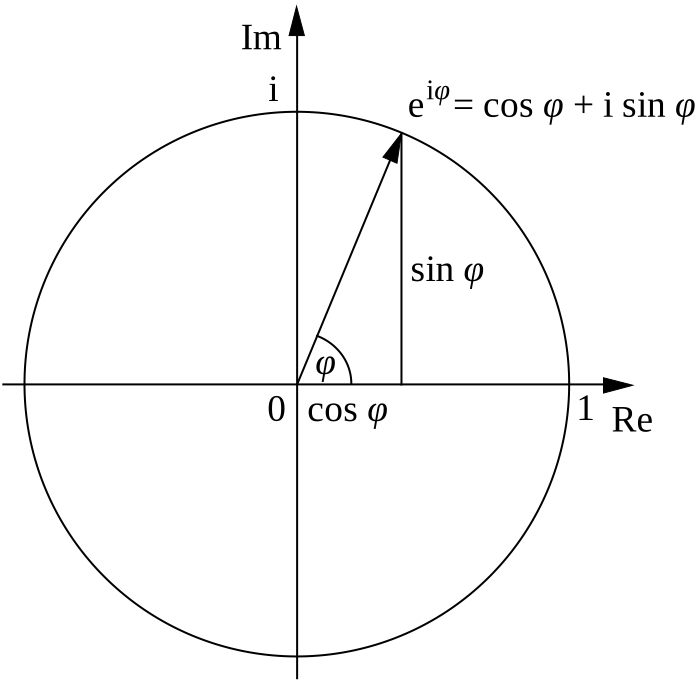
formula
noun
A mathematical relationship or rule expressed in symbols.
Example: We learn to solve the equation ax 2 + bx + c by the following formula.
fr: formule
lab coat
noun
A white protective coat worn by workers in a laboratory.
Example: I need my lab coat for the chemical experience.
fr: sarrau
laboratory
noun
A room or building equipped for scientific experiments, research, or teaching, or for the manufacture of drugs or chemicals.
Example: I was assisted with the implementation of the GCDandLCM procedure by a colleague and by supervisors in the laboratory during practical sessions.
fr: laboratoire
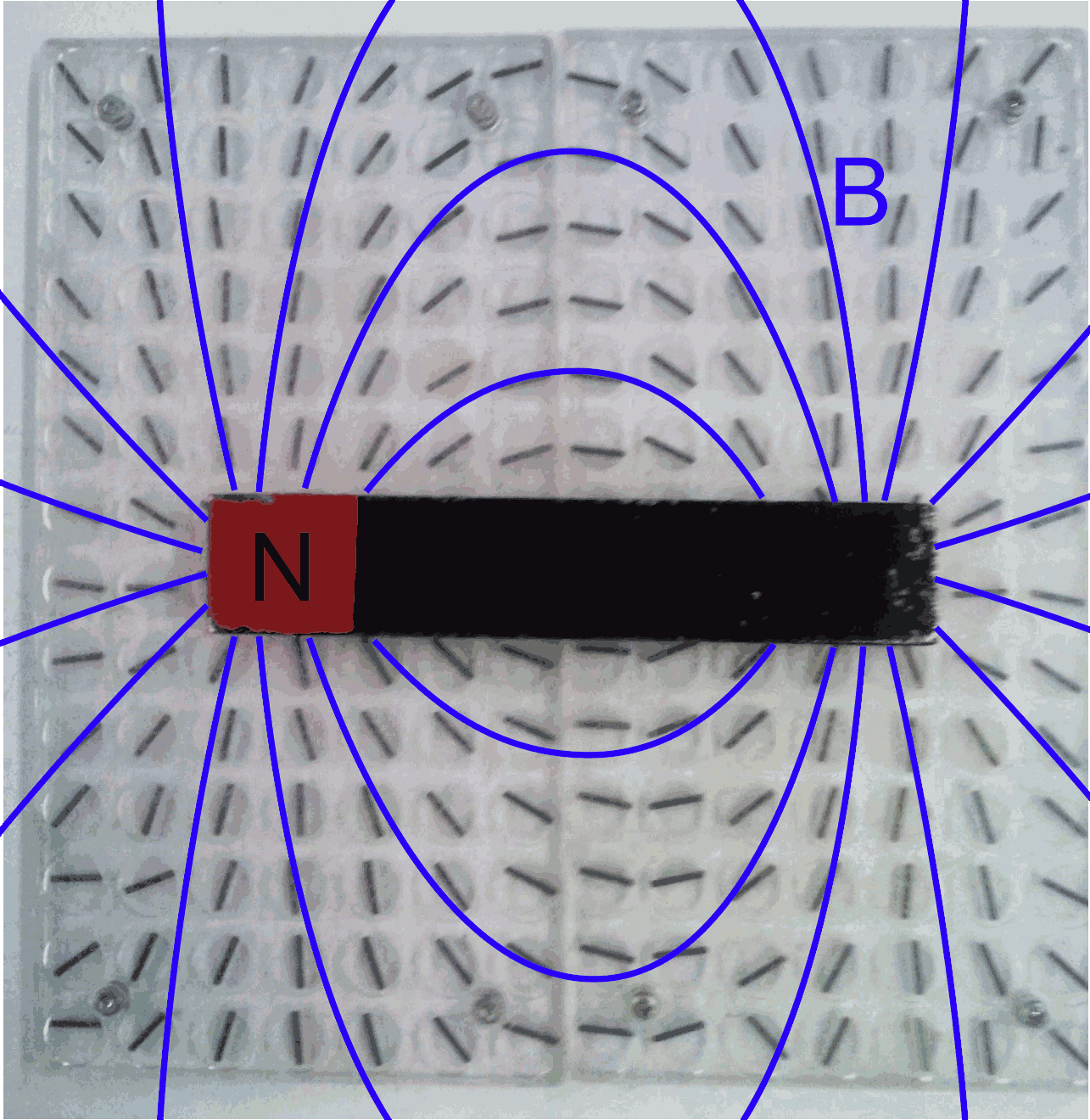
magnetism
noun
A physical phenomenon produced by the motion of electric charge, resulting in attractive and repulsive forces between objects.
Example: The reduction of electricity and magnetism to one force governed by a few equations in Maxwell's theory of electromagnetism is in stark contrast to the many variables and interpretations required in astrology to predict aspects of human behaviour.
fr: magnétisme
mathematics
noun
The abstract science of number, quantity, and space. Mathematics may be studied in its own right ( pure mathematics ), or as it is applied to other disciplines such as physics and engineering ( applied mathematics ).
Example: Rene Descartes (1596-1650) was not just a Psychologist; he also developed influential Philosophical theories and contributed to the fields of mathematics and Geometry.
fr: mathématique
molecule
noun
A group of atoms bonded together, representing the smallest fundamental unit of a chemical compound that can take part in a chemical reaction.
Example: This can be seen in water (H2O), which is the chemical interaction of one oxygen molecule and two hydrogen.
fr: molécule
physics
noun
The branch of science concerned with the nature and properties of matter and energy.
Example: Through animation the film-makers can create anything they desire without being hindered by the laws of physics.
fr: physique
report
noun
An account given of a particular matter, especially in the form of an official document, after thorough investigation or consideration by an appointed person or body.
Example: Following this report the most likely cause for this patient's localised pain in the dorsal region of the foot was obstruction of the posterior tibial, secondary to an embolus derived from within the popliteal aneurysm.
fr: rapport
research
noun
The systematic investigation into and study of materials and sources in order to establish facts and reach new conclusions.
Example: Their research centred around traditional concepts such as mechanics, optics, astronomy and planetary motion.
fr: recherche
science
noun
The intellectual and practical activity encompassing the systematic study of the structure and behaviour of the physical and natural world through observation and experiment.
Example: He seems optimistic about Bodycote's future growth, since he believes that markets such as aerospace and health science have great potentials.
fr: science
scientist
noun
A person who is studying or has expert knowledge of one or more of the natural or physical sciences.
Example: Simmel is often described as an artist and a musician, rather than a mathematician or a scientist.